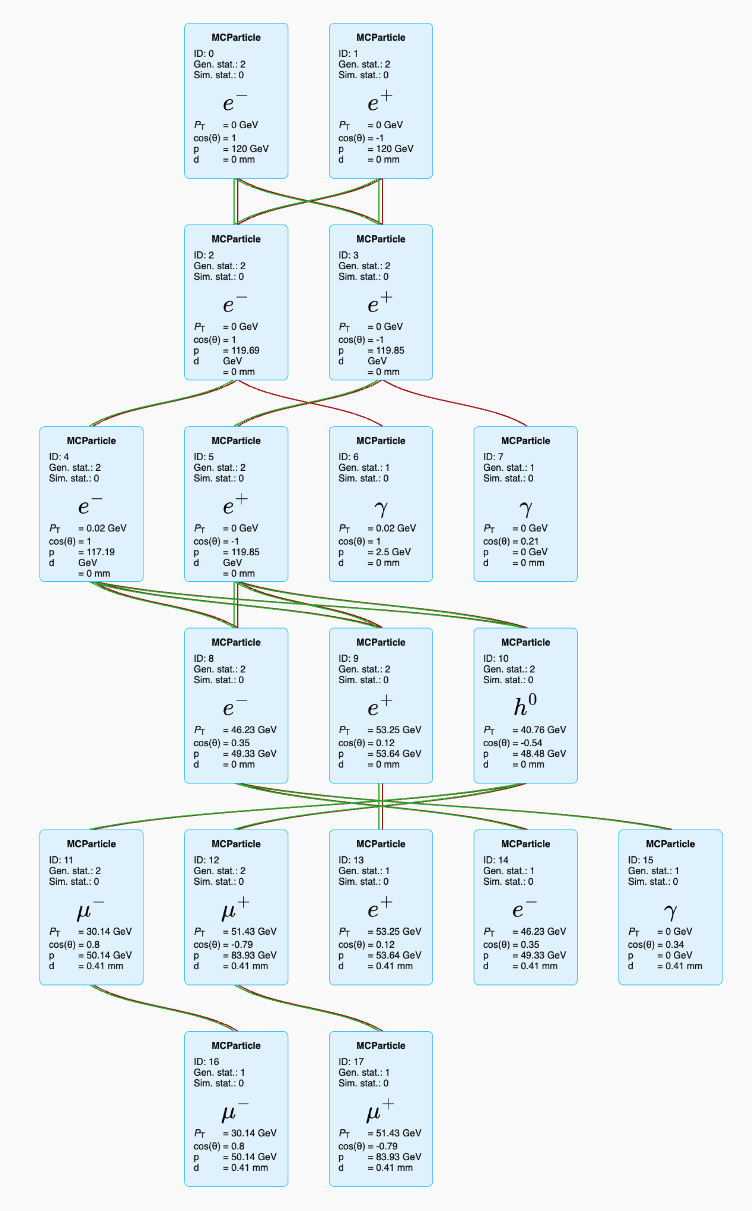
In the eeH samples, there is no Z, as there is interference between ZH and VBF production. I believe in mumuH channel you should be able to identify a Z.
I think the Matrix Element level is already ee–>mumuH, and P8 showered the H inclusively. So there is no record on the Z decay. As long as you know the Higgs decay, the other pair should be Z decay?
The other way will be to generate ee–>ZH with whizard and shower both Z and H with p8.
The Z is only there if resonance insertion is turned on in Whizard (see 10.6.4 in the manual).
Even then, the meaning of these is limited.
Alternatively, you can think of the two electrons that are on the same line as the Higgs as the two electrons in eeH, but depending on what you want to do with them exactly, you might want to take the stable ones that appear later (gen. stat.: 1).
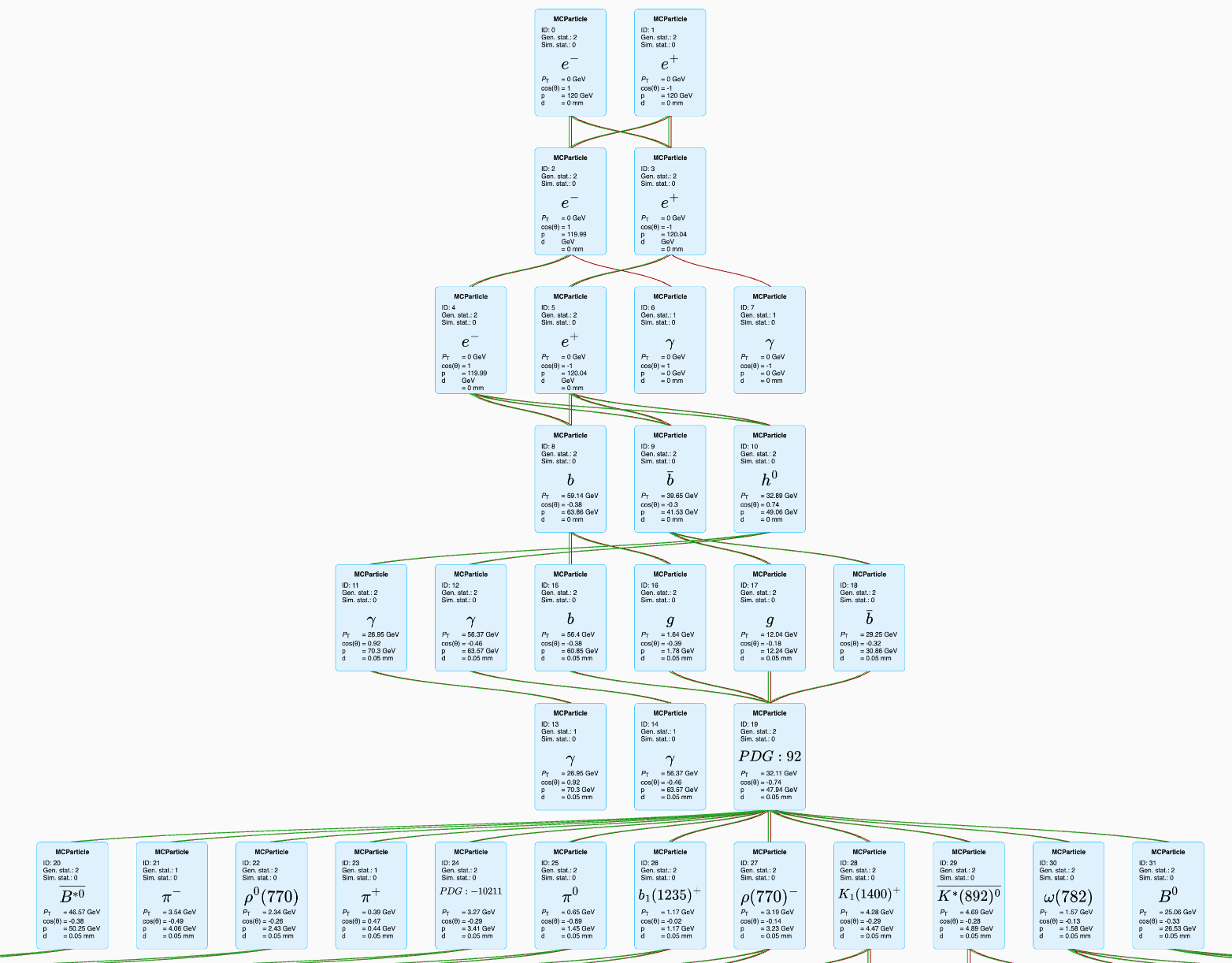
If you want the quarks, you don’t need to do showering. Similar to the first plot you shared, b quarks which are not from Higgs can be considered come from Z boson.
ee–>eeH is special as it doesn’t forbid the VBF process. The two electrons can directly come from the initial electron and positron.
In this events there are 2 quarks b (ID 8 and 15), should I choose the first one or the last one?
And what does PDG 192 mean? Do I choose the quarks whose daughter particle is PDG 192?
It depends on what you want to study. What I can tell you is that ID 8 b quark corresponds to the state before FSR, while ID 15 b quark corresponds to the state after FSR. Do you mean PDG 92 from the plot? If it is not in the PDG ID list, which I believe is the case, then it is a special number reserved for the generator’s internal use, likely related to parton showering.
I want to reconstruct the Z from MC information and verify that the Z I reconstructed from ReconstructedParticles corresponds to the true Z. So I think I would need the quark after FSR.
Yes I meant PDG 92, my mistake.
What does gen. stat. corresponds to?
For the electron pair, are there pair production from the gamma in FSR?